
What Do They Check on an MOT?
An MOT checks important safety and environmental parts of your vehicle to make sure it meets the legal minimum standard at the time of the test. This guide explains what is checked, what is not checked, what common failure points to look for, and how to prepare before booking your MOT.
Quick answer: what do they check on an MOT?
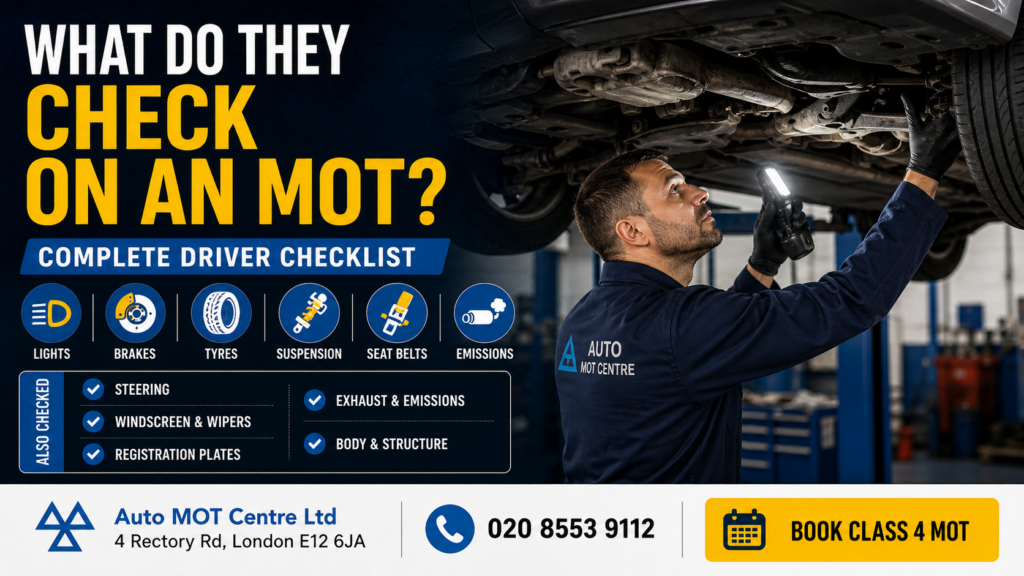
During an MOT, the tester checks key safety and environmental items including the body structure, lights, brakes, tyres, steering, suspension, seat belts, mirrors, windscreen, wipers, washers, registration plates, exhaust and emissions. The MOT checks whether these items meet the legal minimum standard at the time of the test.
The MOT is not the same as a car service. It does not fully inspect the engine, clutch or gearbox, and it does not replace maintenance such as oil, filters, brake fluid or general servicing.
What is an MOT test?
An MOT is a legal test for most vehicles in the UK once they reach the required age. For most cars, the first MOT is due by the third anniversary of registration, then every year after that.
The purpose of the MOT is to check whether your vehicle meets minimum road safety and environmental standards. It is a snapshot of the vehicle’s condition on the day of the test, not a guarantee that the car will remain fault-free for the next 12 months.
Need a Class 4 MOT in Manor Park?
Auto MOT Centre Ltd provides Class 4 MOT testing at 4 Rectory Rd, London E12 6JA. Book online or call our team if your MOT is due soon.
Full MOT checklist: what gets checked?
The MOT covers many important parts of your vehicle. The tester will inspect these areas to decide whether the vehicle passes, fails, or passes with minor defects or advisory items.
| MOT area | What the tester checks | Examples of possible problems |
|---|---|---|
| Body, structure and general condition | The vehicle body, chassis, structural areas, sharp edges, corrosion and damage. | Excessive corrosion, sharp edges, insecure panels or structural damage. |
| Registration plates | Number plates must be secure, readable, correctly spaced and in suitable condition. | Cracked plates, incorrect spacing, unreadable characters or insecure plates. |
| Vehicle Identification Number | The VIN must be present and readable where required. | Missing, unreadable or inconsistent VIN details. |
| Lights and electrical equipment | Headlights, brake lights, indicators, hazard lights, rear lights, fog lights and reflectors. | Blown bulbs, poor aim, damaged lenses, warning lights or faulty indicators. |
| Steering | Steering wheel, steering column, power steering, linkages and excessive play. | Excessive play, rough steering operation, leaks or insecure steering parts. |
| Suspension | Springs, shock absorbers, suspension arms, joints and general suspension condition. | Broken springs, leaking shock absorbers, worn bushes or insecure components. |
| Brakes | Brake condition, brake operation, braking performance, parking brake and relevant warning lights. | Low braking efficiency, worn parts, brake imbalance, warning lights or insecure components. |
| Tyres and wheels | Tyre tread, tyre size, tyre condition, wheel condition and suitability. | Low tread, cuts, bulges, exposed cords, incorrect tyres or damaged wheels. |
| Seat belts and seats | Seat belt condition, locking, security, warning systems and seat security. | Frayed belts, faulty buckles, insecure seats or warning light faults. |
| Driver visibility | Windscreen, mirrors, wipers, washers and anything that affects the driver’s view. | Cracked windscreen, failed wipers, empty washer bottle or damaged mirrors. |
| Exhaust and emissions | Exhaust security, leaks, noise, smoke and emissions performance. | Excessive smoke, emissions failure, exhaust leaks or missing emissions equipment. |
| Fuel system | Fuel tank, fuel cap, leaks and fuel system condition. | Fuel leaks, missing cap, insecure tank or unsafe fuel system condition. |
| Doors, bonnet and boot | Doors, hinges, latches, bonnet, boot/tailgate and load security. | Doors not opening correctly, insecure bonnet or boot not closing properly. |
| Horn | The horn must work correctly and be suitable for road use. | Horn not working, too quiet or unsuitable sound. |
What is not checked during an MOT?
One of the most common misunderstandings is that an MOT is a full mechanical inspection. It is not. Passing an MOT does not mean the car has been serviced, and it does not mean every mechanical part has been checked in detail.
- The MOT does not fully check the condition of the engine.
- The MOT does not fully check the clutch.
- The MOT does not fully check the gearbox.
- The MOT does not include an oil and filter change.
- The MOT does not replace air filters, fuel filters or spark plugs.
- The MOT does not check every hidden or internal mechanical component.
- The MOT does not guarantee the car will stay problem-free for the next year.
MOT pass does not mean “no maintenance needed”
A car can pass its MOT and still need servicing, brake maintenance, tyres, wheel alignment, diagnostics or repair work. If you want a better picture of the car’s overall condition, book a service or inspection as well as the MOT.
Lights checked during an MOT
Lights are one of the easiest things to check before your appointment. The tester will check that required lights work, are secure, are the correct colour and are not badly damaged or obscured.
Before your MOT, check:
- Headlights
- Sidelights
- Brake lights
- Indicators
- Hazard lights
- Rear lights
- Rear fog light where required
- Number plate lights
- Reflectors
Ask someone to stand behind the car while you press the brake pedal, or check the reflection in a window or garage door. A simple blown bulb can cause an MOT failure.
Brakes checked during an MOT
Brakes are a major safety item. The MOT tester checks brake condition, operation and performance. This includes the service brake, parking brake and relevant dashboard warning lights.
Common brake-related MOT issues include:
- Brake warning light showing on the dashboard
- Brake pads or discs badly worn
- Uneven braking performance
- Poor parking brake performance
- Brake fluid warning light
- Insecure or damaged brake components
- Leaking brake fluid
If your brakes squeal, grind, vibrate or feel weak, it is better to ask the garage to inspect them before the MOT.
Worried about brakes before your MOT?
Auto MOT Centre can help with brake checks, brake repairs and MOT testing from our Manor Park garage.
Tyres checked during an MOT
Tyres are another common MOT failure area. The tester checks tyre tread, condition, size, type and suitability. Tyres must be safe, legal and free from serious damage.
Before your MOT, check:
- Tyre tread depth
- Cuts or splits in the sidewall
- Bulges or lumps
- Exposed cords
- Uneven wear
- Damaged wheels
- Incorrect tyre type or size
Uneven tyre wear can also point to alignment or suspension issues. If one side of a tyre is wearing faster than the other, ask for a tyre or wheel alignment check.
Windscreen, wipers and washers checked during an MOT
The tester checks whether the driver has a clear view of the road. This includes the windscreen, wipers, washers and anything that blocks the driver’s view.
Common visibility problems include:
- Wipers split or not clearing the screen properly
- Empty screenwash bottle
- Washer jets not working
- Cracks or chips in the driver’s view
- Obstructions such as stickers, dash mounts or hanging items
- Damaged or insecure mirrors
A very simple way to reduce MOT risk is to top up your screenwash and replace damaged wiper blades before test day.
Steering and suspension checked during an MOT
Steering and suspension are checked for safety, security and excessive wear. The tester may inspect components over a pit or on a hoist and check for play, roughness, damage or leaks.
Warning signs before your MOT:
- Car pulling to one side
- Knocking noises over bumps
- Steering feels loose or heavy
- Uneven tyre wear
- Vehicle sits lower on one corner
- Excessive bouncing after going over bumps
If you notice these symptoms, book an inspection before the MOT. Steering and suspension faults can become major or dangerous depending on severity.
Exhaust and emissions checked during an MOT
The MOT checks the exhaust system and emissions. The exact emissions test depends on the vehicle type, age and fuel. The tester will look for excessive smoke, leaks, insecurity and emissions-related faults.
Possible exhaust or emissions issues include:
- Excessive exhaust smoke
- Exhaust blowing or leaking
- Exhaust too noisy
- Missing or damaged emissions equipment
- Engine management light issues
- Emissions reading above the allowed limit
If your engine management light is on, or the car is smoking more than usual, it is worth booking diagnostics before the MOT.
Seat belts and seats checked during an MOT
Seat belts are checked for condition, security and correct operation. Seats are also checked to make sure they are secure and safe.
Before test day, check:
- Seat belts pull out and retract properly
- Seat belts click securely into the buckle
- Belts are not badly frayed, cut or damaged
- Seats are secure
- Driver’s seat can be adjusted and secured
- Airbag or seat belt warning lights are not showing
Registration plates and VIN checked during an MOT
The tester checks the vehicle registration plates and Vehicle Identification Number, also known as the VIN. Number plates must be readable, secure and correctly displayed.
Common number plate issues:
- Dirty or unreadable plates
- Cracked or damaged plates
- Incorrect spacing
- Missing number plate light
- Insecure plate fixing
- Characters altered or difficult to read
Clean your number plates before your MOT and check that the rear number plate light works.
Doors, bonnet, boot and bodywork checked during an MOT
The MOT includes checks on doors, latches, hinges, bonnet security, boot or tailgate closure, body condition and structural areas.
Possible issues include:
- Doors not opening correctly from inside or outside where required
- Bonnet not securing properly
- Boot or tailgate not closing properly
- Sharp edges likely to cause injury
- Excessive corrosion in important areas
- Insecure panels or unsafe body damage
Dashboard warning lights checked during an MOT
Some dashboard warning lights are relevant to the MOT. Warning lights related to systems such as brakes, ABS, airbags, electronic stability control and emissions can affect the test result.
If warning lights are showing before your appointment, do not ignore them. Book a diagnostic check so the issue can be investigated properly.
Dashboard warning light on?
Auto MOT Centre provides diagnostics, repairs and MOT testing in Manor Park, London E12.
What do MOT result categories mean?
After the MOT, the result may show advisory, minor, major or dangerous issues. Understanding these categories helps you know what to do next.
| Result type | Meaning | What you should do |
|---|---|---|
| Pass | The vehicle met the MOT standard at the time of the test. | Keep the certificate/result and monitor any advisory notes. |
| Advisory | An item is not currently a failure, but it may need attention in future. | Plan repairs before the issue becomes worse. |
| Minor | A defect has no significant effect on safety or the environment. | The vehicle can pass, but the issue should still be repaired. |
| Major | A defect may affect safety, put other road users at risk, or affect the environment. | The vehicle fails and needs repair. |
| Dangerous | A defect is a direct and immediate risk to road safety or has a serious environmental impact. | Do not drive the vehicle until it is repaired. |
Simple checks to do before your MOT
You cannot guarantee a pass, but a few quick checks can help you avoid simple failures.
- Check all lights and indicators.
- Check brake lights with help from another person or a reflection.
- Check tyre tread and look for cuts, bulges or exposed cords.
- Top up screenwash.
- Check wipers clear the windscreen properly.
- Make sure the horn works.
- Clean registration plates.
- Check number plate lights.
- Remove clutter from the boot, seats and footwells.
- Check mirrors are secure and usable.
- Look for dashboard warning lights.
- Tell the garage about any known issues before the test starts.
Should you book a service before an MOT?
A service can help identify maintenance problems before they become MOT failures. For example, a service may highlight worn brakes, low fluid levels, tyre issues, filters, leaks or general maintenance needs.
However, a service does not guarantee an MOT pass, and an MOT pass does not mean the car has been serviced. They are different checks with different purposes. If your car is due for both, booking a service and MOT together can be convenient.
Where can I book an MOT in Manor Park?
Auto MOT Centre Ltd provides Class 4 MOT testing at 4 Rectory Rd, London E12 6JA. We support drivers from Manor Park, East Ham, Forest Gate, Ilford, Newham and nearby East London areas.
You can book online, check your MOT status, or call our team if you have questions before your appointment.
Auto MOT Centre details
Garage: Auto MOT Centre Ltd
Address: 4 Rectory Rd, London, E12 6JA
Phone: 020 8553 9112
Opening hours: Mon–Sat 9:00 AM – 6:00 PM, Sunday 10:00 AM – 4:00 PM
Lunch break: 12:15 PM – 12:40 PM
FAQs about what is checked on an MOT
What do they check on an MOT?
The MOT checks important safety and environmental items including lights, brakes, tyres, steering, suspension, seat belts, mirrors, windscreen, wipers, registration plates, body condition, exhaust and emissions.
Does an MOT check the engine?
The MOT does not fully check the condition of the engine. It may identify issues linked to emissions, warning lights or safety, but it is not a full engine inspection.
Does an MOT check the clutch or gearbox?
No. The MOT does not check the general condition of the clutch or gearbox. A car can pass an MOT and still have clutch or gearbox problems.
Are tyres checked during an MOT?
Yes. Tyres are checked for tread, condition, suitability and serious damage such as cuts, bulges or exposed cords.
Are brakes checked during an MOT?
Yes. Brakes are checked for condition, operation and performance. Brake warning lights and parking brake operation can also affect the result.
Can a warning light fail an MOT?
Some warning lights can cause an MOT failure, especially those linked to safety or emissions systems such as brakes, ABS, airbags or engine/emissions faults.
What is the most common MOT failure?
Common MOT failure areas include lights, tyres, brakes, suspension, windscreen/wipers/washers and emissions. Many simple issues can be checked before test day.
Where can I book a Class 4 MOT near Manor Park?
You can book a Class 4 MOT with Auto MOT Centre Ltd at 4 Rectory Rd, London E12 6JA. Book online or call 020 8553 9112.
Book your Class 4 MOT in Manor Park
Need an MOT in Manor Park, East Ham, Forest Gate, Ilford or Newham? Book online with Auto MOT Centre today.
Sources
This guide uses information from GOV.UK and DVSA guidance on what is checked during an MOT and how MOT results are recorded.